


Beyond the Scroll: Rethinking Socially Engaged Practice
One-Day Symposium, Workshops & Evening Social
Thursday 16 April 2026 10am–4pm, followed by evening social (4pm onwards)
Doncaster Unitarian & Free Christian Church, 60a Hall Gate, Doncaster DN1 3PB
FREE ENTRY

ArtBomb invites artists, activists and the curious public to a day of talks, workshops and live interventions exploring how socially engaged practice can reclaim focus and meaning in an age of distraction.
Taking place in ArtBomb’s high street hub — hosted in partnership with the Unitarian Church — Beyond the Scroll examines the double meaning of the “scroll” — sacred script and endless digital feed. Against a backdrop of algorithmic attention, anxiety and cultural noise, the forum asks how artists can interrupt habitual ways of seeing and speaking, and how creative practice can be genuinely of service.
Building on recent commissions including Apartheid Apartments by Spelling Mistakes Cost Lives, and upcoming 2026 projects addressing homelessness and migration, the day brings together quick-fire provocations, open discussion and hands-on workshops in painting, zine-making and subvertising. The evening continues with film, spoken word, drinks, a private viewing of Matthew Humphreys' Tendresse exhibition in the ArtBomb shop and informal conversation.
Themes include digital addiction, commodified attention, surveillance culture and the risks of “cultural welfarism.” Contributors will explore slow practice, critical digital literacy, hybrid spaces and art as shelter — strategies for sustaining care, agency and collective imagination beyond the feed.
Working from a messy, mixed high street rather than a sealed cultural venue, ArtBomb insists on art as interference: negotiated in noise, grounded in place, and open to friction.
Join us. Let’s go beyond the scroll.
Spaces are limited, please email admin@artbombuk.com to reserve your spot!
Messy Provocations: Art, Authenticity, and the Age of Endless Feeds
By Mike Stubbs
Let’s drop the polish and start with doubt.
After the war, certainty felt dangerous. Science had already begun to loosen its own foundations — relativity bending time and space, quantum mechanics insisting the observer interferes with what is observed. Knowledge became provisional. Systems became relational. You couldn’t pretend to stand outside what you were measuring, and there seemed less time for simply being in life.
Art moved in parallel.
Post-war modern art practice dismantled orthodoxy because orthodoxy had proved lethal. Grand narratives — religious, political, aesthetic — had marched people into catastrophe. So artists fractured perspective, loosened authorship, displaced meaning from object to encounter. Deconstruction wasn’t fashion; it was structural scepticism — whether expressed through punk, hip hop, conceptualism or community action. It was a refusal to inherit belief without interrogation and the promise of democratised interaction.
I grew up around that kind of scepticism. A science technician dad fascinated by modernity, wary of faith, suspicious of piety. At school I wanted to talk about evolution. I prodded at the edges of what was presented as obvious. It leaves you with a taste for the awkward, the experimental — and a suspicion of anything too neatly packaged.
Which brings me to the scroll.
The scroll used to be sacred text — doctrine, instruction, order. Now it’s the feed. Endless, algorithmic, persuasive. It scripts authenticity, packages outrage and joy, instrumentalises connection. It tells us how to perform ourselves. It feels fluid, but it’s another orthodoxy — softer, more seductive, a kind of cultural managerialism.
ArtBomb sits awkwardly against that smoothness.
We’re based in a shop on a busy mixed high street. Not picturesque. Wedged between vape shops with fluorescent signage, barbers with constant churn, bars pushing out the same playlist — “all night long, all night…” — delivery drivers idling, people shouting across the pavement. It’s messy, ordinary, sometimes abrasive. It’s also a place where people meet, argue, laugh, share common ground.

Our landlord and partner is the Unitarian Church — historically a place dedicated to belief, dissent and radical thought. That history lingers. A site of sermon making space for creative and cultural experimentation.
There’s nothing romantic about who comes in. Some step through the door out of curiosity. Some by accident. Some don’t come in at all but watch from the pavement. Plenty walk past without a glance. You’re competing with beer, disposable vapes, shifts at logistics hubs, Uber routes, racegoers, those without a regular place to sleep, people in transit. ArtBomb is situated in an in-between place. The city centre demographic shifts constantly; Doncaster has become, once again a market again, a destination for those priced out elsewhere or seeking accessible labour.
One doesn’t get to curate that public — unless you want to live in a gated community.
That’s precisely why it’s compelling.

The work we host — and the projects that spill into the street during the ArtBomb Festival such as Argue with a Woman by psychoanalyst Anouchka Grose — don’t float above the public realm; they rub against it. They interfere with the choreography of consumption and leisure. They introduce subjects that aren’t easily reduced to content.
When Fiona Cahill brought Rendition into the shop, the focus was on extraordinary rendition — Irish state detention, disappearance of babies, the bureaucratic language that sanitises violence. Legal texts, redactions, testimony. In a church on a high street concerned with transactions. It wasn’t decorative; it was forensic.
Apartheid Apartments confronted spatial segregation head-on — how housing policy and architecture encode racial and economic division. On a street in Doncaster where housing pressure is lived daily, global histories of apartheid collided with local realities. It wasn’t metaphor. It was structure made visible and immediately and uncannily presenting a double take on Gaza.
The Bare Project explored care and food – sustenance distributed through a temporary and hyper local food distribution network and production space occupying the shop, this exemplifies many of the interventions which have experimented with the space as somewhere to take a risk and treat the shop as an artwork, in itself.
Terry Hudson's The Little Anarchist Bookshop reintroduced the printed word into a site once structured around sermon, but without nostalgia. Shelves of anarchist theory, critiques of capitalism, histories of mutual aid and direct action. Kropotkin next to contemporary pamphlets. You could browse, argue, disagree, learn how to organise your own festival, make your own zine and program a Raspberry Pie and Linux. Political philosophy at street level, between vape advertising and bar promotions, a hack like Apartheid Apartment, but more friendly.
These takeovers insisted on reflection, contemplation and curiosity — not as mood, but as method, slowing the tempo, asking for sustained looking in a culture trained for reaction.
Deep engagement in that context isn’t cosy. It’s not just a tidy workshop with a sign-up sheet (though we also do that). It’s sustained presence in noise. It’s returning when turnout is thin. It’s listening to someone as interested in arguing as agreeing. It’s accepting that co-production is uneven and that power doesn’t dissolve because you’ve invited participation.
The "Care" Trap: There is a risk that socially engaged art becomes a, "cultural welfarism" or "therapeutic" tool for institutions, focusing on superficial well-being rather than confronting systemic issues and looking at systemic causes of inequality, mental health and hardship - this demands addressing issues of class and owning politics for the common good long term.
If quantum theory taught us that the observer alters the experiment, then a high street setting makes that alteration unavoidable. The street alters the work. The work alters the street — even if only slightly. The artist is implicated in the noise, the commerce, the tension of the place.
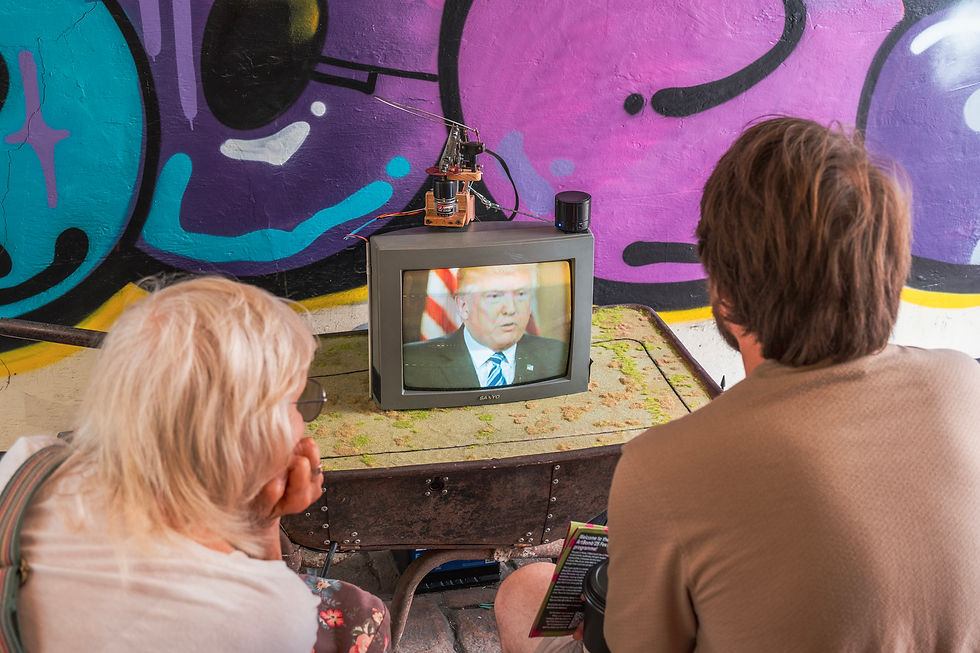
And all of this unfolds against broader instability. Since Trump, distortion has become tactic. “Fake news” operates strategically. Truth becomes performative and the work of The Yes Men, Maverick and Led by Donkeys essential in an era ICE raids and the global drift toward authoritarian postures, and shared reality feels under pressure.
In that climate, authenticity is slippery. Disruption can be commodified. Engagement can be instrumentalised. Dissent can be branded, so provocation must be more than surface shock.
On a high street like this, provocation might be as simple as holding space for complexity where everything else is immediate and transactional. Allowing disagreement rather than smoothing it over for optics. Acknowledging that some projects will fail to connect.
Understanding that collaboration with others — artists, neighbours, institutions — is vital but never neutral.
Socially engaged practice, at its strongest, builds situations slowly, through repetition and friction. It recognises that authorship is shared and therefore complicated. With this in mind, we are progressing our Oasis Garden, an outdoor project called "Stories Grow Here" that draws on our research and practice commissions: The Anti-Social Housing Agency by Ciara O’Rourke and Jack Clarke and Refugee Dreams by Angela Robson.
The relationships developed will feed into new designs for the Unitarian courtyard, a secret urban garden hiding in plain sight on Hall Gate. Bringing together street art with an edible gardening scheme, we plan to develop a vibrant outside space for those who wander in through the gates to experience painting, music, film and conversation- an informal space for chance encounters and alternative forms of "community outreach".
Beyond the Scroll isn’t about romanticising the street or imagining spontaneous awakening. It’s about choosing to work in friction. To occupy a site layered with belief — from Unitarian sermons to vape promotions — and test what art can do there.
The inheritance from post-war doubt still holds: question the frame. Expose the structure. Accept instability and find new ways to counter anxiety, addiction and widespread issues with mental health.
Let the work be messy. Let co-production tangle authorship. Don’t pretend it’s utopian. It’s negotiated in noise. Shaped by commerce. Interrupted by basslines and football chants.
In a culture addicted to seamless feeds and controlled environments, there’s something quietly defiant about insisting on art as interference — in the middle of a loud, imperfect, very real street — and refusing to let the script, sacred or digital, have the final word so that conversation can resume and the small child (pictured in lead image above) gets a chance to make eye contact with the father on his phone.

